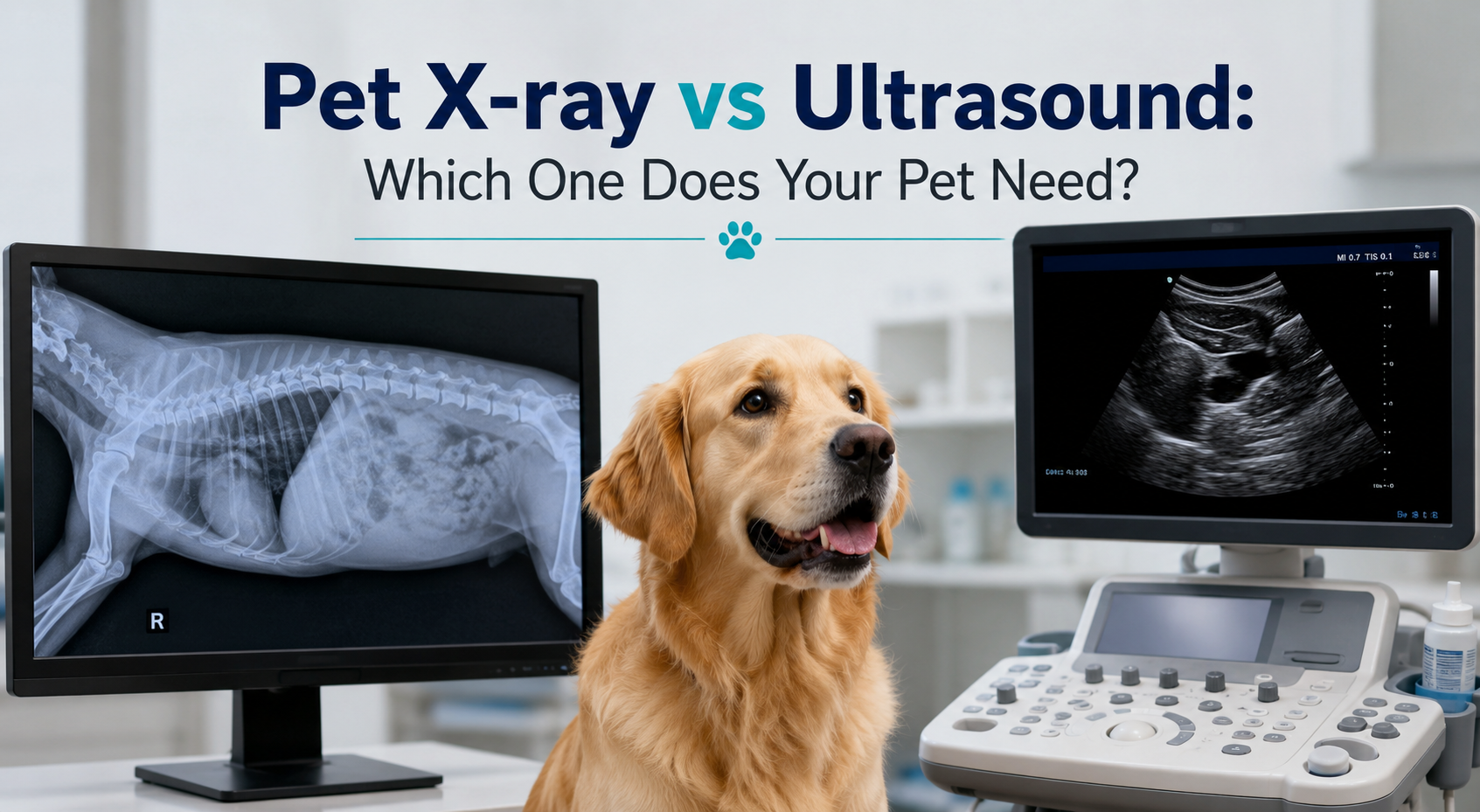
Pet X-ray vs Ultrasound: Which One Does Your Pet Need? – When your pet shows symptoms of illness or injury, veterinarians frequently suggest diagnostic imaging to find the current problem. Pet X-Ray vs Ultrasound are among the most common imaging methods, and many pet owners are unsure which option is right for their pets. Even though both techniques help veterinarians diagnose health conditions, they serve different purposes and give different kinds of information. In this guide, let’s understand how these imaging tools work to help you make informed decisions about your pet’s healthcare.
What Is a Pet X-Ray?
A pet X-ray, also known as radiography, uses low doses of radiation to create images of your pet’s internal structures. An X-ray is mainly useful for examining bones, joints, lungs, and some other solid objects within the body. Vets are often able to diagnose broken bones, arthritis, ingested foreign bodies, pneumonia, or bladder stones by using an X-ray.
Common Uses of Pet X-Rays
- Bone fractures and disruptions
- Problems with the joints and arthritis
- Dental problems
- Lung diseases
- Detection of foreign objects
- Assessment of abdominal blockages
An X-ray is a quick and non-invasive procedure. It usually takes as little as a few minutes to do, although mild sedation may be administered to calm the animal. Digital X-rays allow veterinarians to quickly send images to specialists.
What is a Pet Ultrasound?
A pet ultrasound is performed by directing high-frequency sound waves into the pet’s body to create real-time images of soft tissue structures and the internal organs. Unlike X-rays, the information is gathered using moving images. Ultrasound commonly evaluates organs, such as the liver, kidneys, spleen, heart, and bladder.
Common Uses of Pet Ultrasounds
- Examining abdominal organs
- Identifying tumors or cysts.
- Monitoring during pregnancy
- Diagnosing heart conditions
- Evaluating soft tissue injuries
- Determining the presence of fluid accumulation
Ultrasound is painless and does not emit radiation. It is particularly useful where the veterinarian needs a better examination of soft tissue structures that may not be clearly visible on X-rays.
“Ultrasound is much better than X-rays at imaging the soft tissues of the body”.
What is the Difference Between a Pet X-Ray and an Ultrasound
As much as both tests are useful in veterinary medicine, both serve different diagnostic purposes.
| Feature | Pet X-Ray | Ultrasound |
| Best For | Bones, lungs, foreign objects | Soft tissues and organs |
| Technology | Radiation imaging | Sound wave imaging |
| Image Type | Static images | Real-time moving images |
| Radiation Exposure | Yes | No |
| Typical Duration | 5-15 minutes | 20-45 |
| Sedation Needed | Sometimes | Rarely |
When Veterinarians Suggest X-Rays
Veterinarians frequently choose X-rays as the first diagnostic tool because they instantly reveal structural abnormalities. X-rays usually provide immediate answers if your pet has suffered trauma, suspected fractures, or difficulty breathing. Also, they are commonly used to detect swallowed objects or intestinal obstructions.
When Veterinarians Suggest Ultrasound
Ultrasounds are used when a veterinarian requires complete information about soft tissues and organs. For example, if your pet has unexplained vomiting, liver disease, urinary problems, or suspected tumors, an ultrasound provides clearer visualization than radiographs. Also, ultrasound can guide biopsies and fluid collection procedures safely.
Do Pets Really Require Both X-Rays and Ultrasounds?
Yes. In a lot of veterinary cases, both methods of imaging are needed. X-rays and ultrasounds are complementary to each other, as they give different views and information. E.g., an X-ray could show an enlarged organ, but an ultrasound would determine the reason.
A veterinarian elaborated that some soft foreign objects are not so distinguishable on an X-ray image, yet are easily seen through ultrasound. This is one example of why a veterinarian may try both techniques.
X-Rays and Ultrasounds of Pets: Are They Safe?
Both of these procedures are safe if carried out by experienced veterinary professionals.
Safety of X-Rays
Modern veterinary X-rays use very low doses of radiation. Lead protection is used to reduce unnecessary exposure for both the animal and the veterinarian.
Safety of Ultrasounds
Diagnosing with ultrasound offers a safe method for our pets, as there is no radiation involved in ultrasound, making it one of the safest imaging procedures for pets. It is used so often, even in pregnancy investigations.
What Is the Price of Pet Imaging Procedures?
The price of pet imaging diagnostics depends on the location, veterinarian, and type of diagnostic test. Generally:
- X-rays for pets are cheaper
- Ultrasound imaging is generally more expensive due to the special equipment
Some additional fees may be needed if anesthesia or consultations with specialists are required.
How to Decide Between Imaging Tests Your Pet Needs
The decision between a pet X-ray vs. an ultrasound relies entirely on your pet’s symptoms and the veterinarian’s clinical evaluation. Your veterinarian will suggest the most appropriate diagnostic tool based on the suspected condition.
Your Pet May Require An X-Ray If:
- Your pet is limping or injured
- There is suspected bone damage
- Your pet swallowed a foreign object
- Breathing issues are present
Your Pet May Require an Ultrasound If:
- Your pet has digestive problems
- If organ disease is suspected
- There are unknown abdominal symptoms
- A heart assessment is required
Conclusion
Understanding the difference between Pet X-Ray vs Ultrasound helps pet parents make informed healthcare decisions for their animals. Both imaging methods serve important purposes in veterinary diagnosis and can be used simultaneously to create effective treatment plans.
If you are looking for the best professional veterinary diagnostic services, and at the same time want to make sure that your pets are treated well and stay healthy, consider contacting All Creatures Veterinary Center.
FAQs
Is an ultrasound always better than an X-ray?
No. Ultrasound is more effective for examining soft tissues, whereas X-rays are more suitable for viewing dense tissues.
Does my pet need an anesthetic during X-rays?
Most pets do not require anesthesia, but mild sedation may be used if the pet cannot remain still during the procedure.
Which technique is better for detecting broken bones?
Ultrasound is not ideal for diagnosing fractures. X-rays are better and more effective for bone injuries.
How much time does a pet ultrasound take?
Typically, a pet ultrasound can take between 20 and 45 minutes, depending on the evaluation.
Are pet imaging tests painful?
No, both tests, X-rays and ultrasounds, are generally non-invasive procedures.