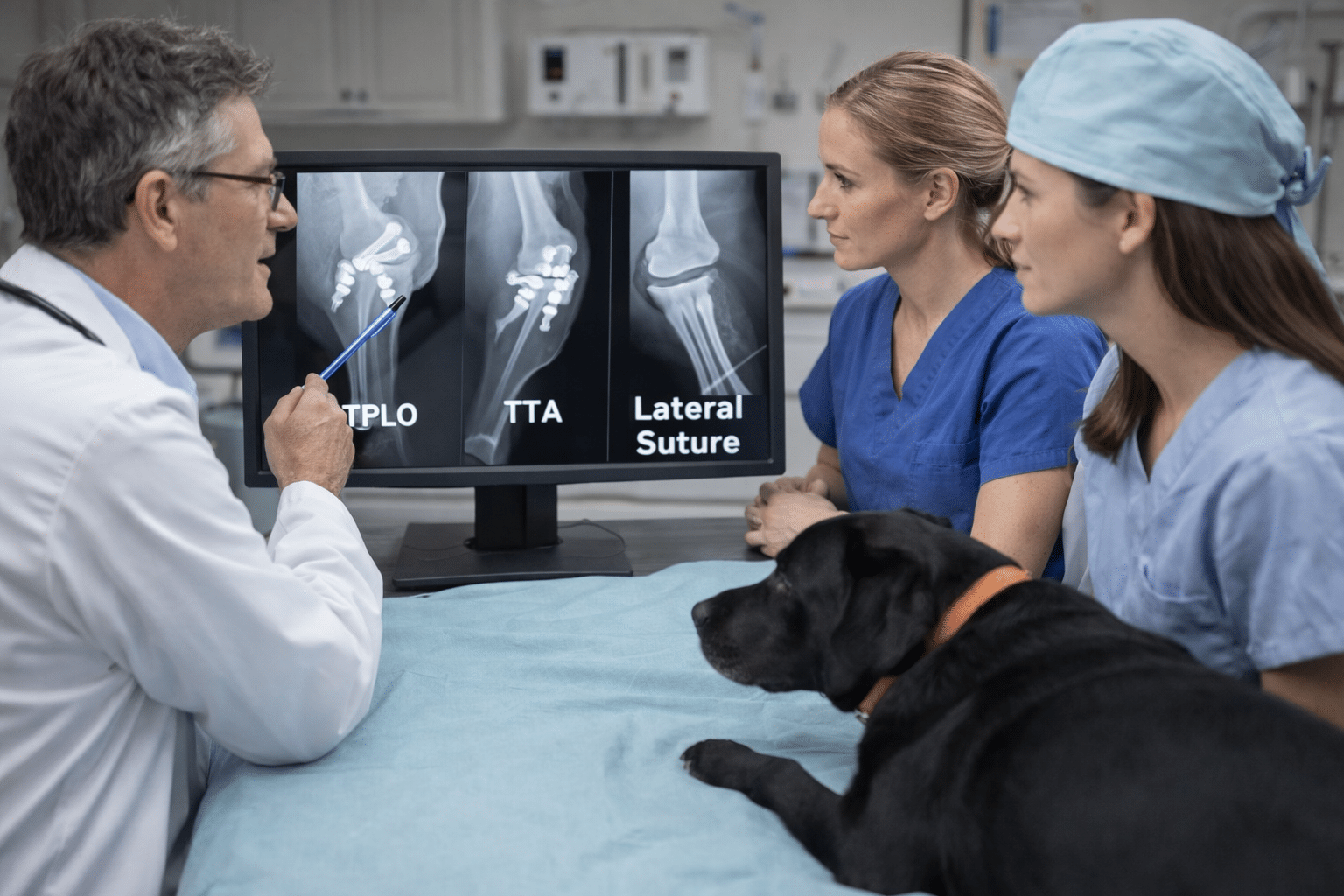
TPLO vs. TTA vs. Lateral Suture: Choosing the Right CCL Surgery for Your Dog – You have just stepped out of the veterinarian’s center with a diagnosis for your dog’s limp. The initial shock of your dog’s condition soon turns into a flurry of new questions as you start to hear terms like TPLO, TTA, and LFS. When your dog’s movement and well-being are at stake, you want to make the very best decision. Understanding the available CCL surgery options for dogs is essential to making an informed decision.
As of October 2025, veterinary orthopedic surgery for dogs has made tremendous strides, and one procedure has been consistently proven to be the most reliable for getting active dogs back on their paws. By understanding the available treatment options for dogs with a torn CCL, it becomes clear why TPLO surgery is considered the gold standard.
The “Traditional” Fix: Extracapsular Repair (Lateral Fabellar Suture)
The Extracapsular Repair, also known as the Lateral Suture or the “fishing line” fix, is one of the oldest techniques for correcting a torn CCL, dating back to the early days of canine ACL surgery.
How it works:
This form of surgical correction for the torn ligament in the knee of a dog doesn’t involve any cutting of the bone. Instead, a very strong, thick suture, resembling a fishing line, is placed on the outside of the joint. It’s oriented roughly parallel to the original CCL, intended to stop the forward “drawer motion” of the tibia.
Best For:
Very small, inactive dogs, such as those that weigh less than 20-25 pounds, might not benefit from such a complex form of orthopedic surgery.
The Downside:
This is an artificial ligament that stretches, loosens, or even breaks over time, especially in larger or more athletic breeds of dogs. This method works against the biomechanics of the knee rather than correcting them. This leads to further instability, progression of arthritis, and a poorer outcome compared to current methods of dog knee surgery.
A Different Angle: Tibial Tuberosity Advancement (TTA)
TTA is an advanced type of surgery for a dog’s cruciate ligament, similar to TPLO, which alters the geometry of the knee joint to restore stability.
How it works:
This type of canine knee surgery involves making a straight cut in the front of the tibia, referred to as the tibial tuberosity. This section of bone is moved to a new position and fixed using a special plate and screws. This advancement alters the angle of the patellar tendon, thereby neutralizing the forces that cause instability when the dog bears weight on the point.
Best For:
While it was once considered a viable option over TPLO for dog ligament surgery, many veterinary orthopedic surgeons today recommend the TPLO procedure for its more reliable results.
The Downside:
Research indicates that the TTA surgery for dogs may not be as effective for dogs with a very steep tibial plateau. Additionally, studies also suggest a higher incidence of meniscal tears occurring later after surgery compared to the TPLO procedure.
The Gold Standard: Tibial Plateau Leveling Osteotomy (TPLO)
The TPLO procedure is the most recommended dog ACL surgery for CCL tears in medium and large breed dogs with active lifestyles for one simple reason: it is the most reliable solution.
How it works:
Rather than replacing the ligament, TPLO surgery for dogs alters the physical dynamics of the knee joint. The top of the tibia, called the tibial plateau, slants downward. When the CCL ligament is damaged, the femur slides down the slanted top of the tibia.
In TPLO surgery for dogs, the veterinarian makes a precise, curved incision on the tibia. This allows the veterinarian to rotate and level the tibial plateau. A plate and screws hold the top of the tibia in place. When the top of the tibia is level, the femur can no longer slide forward. This makes the joint stable when the dog puts weight on the joint.
Best For:
Medium, large, giant breed, and athletic dogs that require reliable knee ligament stabilization.
The Biomechanical Advantage:
This is the main factor that sets TPLO apart from other surgical procedures for dogs. TPLO not only stabilizes the joint but also corrects the underlying biomechanical problem. This makes the joint stronger, allowing for faster recovery and more activity, such as hiking, running, and exploring the outdoors for the adventurous dog.
Why TPLO is Considered the Gold Standard in 2025
Even though the Lateral Suture and TTA surgical options have their own advantages in certain situations, TPLO dog surgery has become the first choice for the majority of dogs due to the following reasons:
Superior Biomechanics
TPLO surgery tackles the underlying causes of instability in a dog with a damaged CCL.
Predictable and Excellent Results
Veterinary studies over the last few decades have proved that 90-95% of TPLO surgeries on dogs are successful.
Faster Recovery
Dogs that have undergone TPLO surgery recover faster and are ready to bear weight on their legs sooner.
Long-Term Durability
Unlike suture-based surgeries, TPLO is a permanent solution that is less likely to fail over time.
Conclusion
When it comes to choosing the best CCL surgery for your dog, it is a decision that requires careful thought. The ideal procedure depends on the size and age of your dog, and also on their activity level and knee structure. Given that the fall season is here with its promise of pleasant weather, we know how important it is to help your furry friend regain strength and mobility.
Schedule a consultation with our veterinary orthopedic surgical staff to determine your dog’s specific situation and find out why TPLO surgery for dogs is the trusted solution for a speedy return to an active, healthy lifestyle.
FAQs
What is a CCL tear in dogs?
It is a tear in the knee ligament that causes pain and limping in dogs.
Which surgery is best for a dog with a CCL injury?
TPLO surgery is considered to be one of the best options for medium and large-sized dogs.
How long does recovery from dog CCL surgery take?
The recovery process takes about 8-12 weeks in the majority of dogs.
Can small dogs have CCL surgery?
Yes, small dogs are also known to have their CCL ligaments repaired through lateral suture surgery.
Will my dog walk normally after surgery?
Yes, your dog is likely to walk normally after a successful CCL surgery.